
How AI Learns to "Pay Attention" to Sort Recycling with 94.5% Accuracy
Introduction: The Recycling Dilemma
We’ve all stood in front of the recycling bin, holding an item and wondering, "Does this go here?" The challenge of correctly sorting organic from recyclable waste is a common, everyday problem. A sophisticated Deep Learning project now offers a high-tech solution, revealing three impactful takeaways about how teaching an AI to "pay attention" can solve this messy, real-world problem
1. The Real Breakthrough Isn't Just Seeing It's Focusing
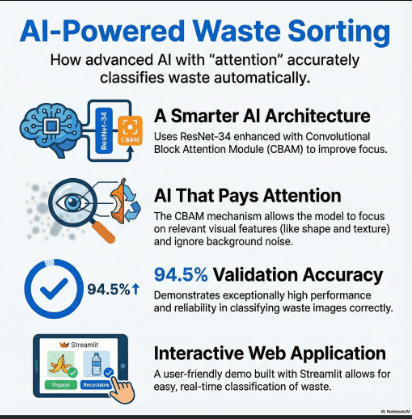
The project's central innovation is the use of a Convolutional Block Attention Module (CBAM). In simple terms, this module teaches the AI model how to "pay attention." Instead of just processing an entire image, CBAM allows the model to focus its attention on the most relevant visual features while actively ignoring distracting background noise.
This is achieved through two complementary mechanisms:
• Channel Attention: This helps the model understand what is important in the image, focusing on the most informative content features. • Spatial Attention: This helps the model understand where the important features are located within the image.
For a task like sorting organic from recyclable materials, this is a game-changer. It allows the model to learn that the smooth, uniform texture of a recyclable aluminum can is a key feature, while the varied, mottled surface of an organic apple core is equally important all while ignoring a cluttered kitchen counter in the background.
2. Building on the Shoulders of Giants: Smart Integration Over Reinvention
The solution presented is not a completely new model built from scratch. Instead, it features a "Hybrid Architecture" that intelligently integrates the CBAM attention module into a proven and powerful "Backbone" model: ResNet-34. This approach highlights a crucial aspect of modern AI development. Significant progress often comes not from reinventing the wheel, but from cleverly enhancing existing, robust tools. By adding the specialized attention module to the well-established ResNet-34 framework, the project leverages the best of both worlds: a strong foundation and a targeted, high-impact enhancement.
3. From Theory to Tangible Results: An AI That Actually Works
The model’s performance metrics prove that this approach is highly effective. The system achieved an impressive Validation Accuracy of 94.5% and an F1-Score of 0.92. To provide a more complete picture, it also scored 92% for both Precision and Recall, demonstrating its consistency in correctly identifying materials. Beyond the raw numbers, the project delivers a complete solution by including an interactive web application built with Streamlit. This tool makes the technology accessible, allowing users to test the model in a browser and demonstrating a clear path from research to a usable demonstration. This high performance is a direct result of the attention mechanism; the model's ability to focus on the subtle textural differences between organic and recyclable items is precisely what drives its high precision and recall.
Conclusion: A Smarter Approach to a Cleaner World
This project demonstrates more than just a way to sort trash; it showcases the power of teaching AI to apply "attention" to solve complex, real-world problems. By integrating a focus mechanism into a solid existing architecture, the system achieves a level of performance that is both accurate and practical.
 If AI can learn to focus on sorting our trash, what other cluttered, complex problems in our world are waiting for a more attentive solution?