
4 Surprising Engineering Lessons from a Palm Tree-Counting AI
1.0 Introduction
Processing massive, high-resolution imagery efficiently is one of the great challenges in modern computer vision. A single drone or satellite photo can easily span gigabytes, overwhelming standard processing pipelines and making real-time analysis seem impossible. Engineers often face a difficult trade-off between image detail and computational feasibility.
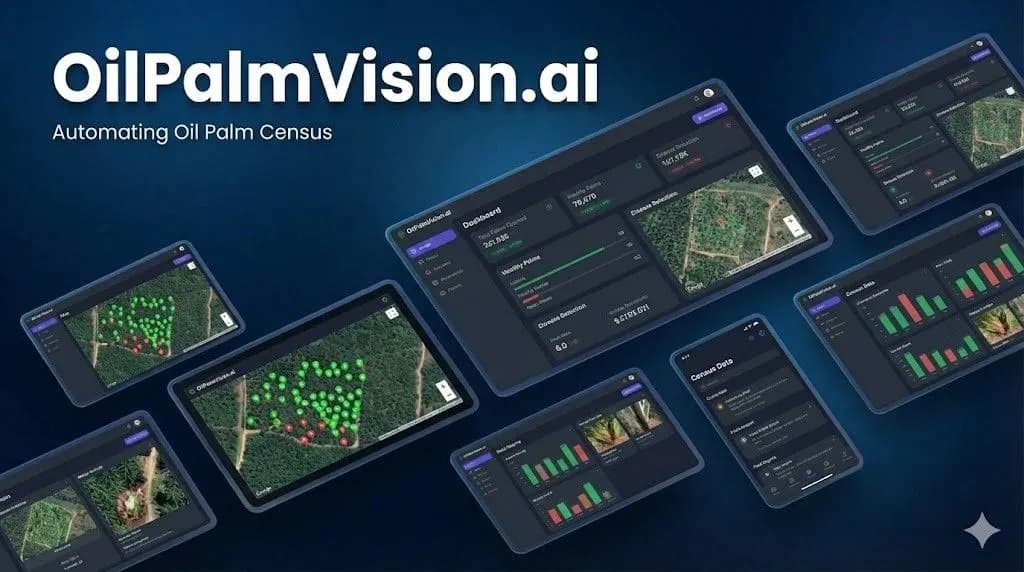
To find solutions, it's useful to look at specialized applications. OilPalmVision, a platform designed to automate oil palm tree census from aerial imagery, serves as an excellent case study. By examining its architecture, we can uncover clever engineering patterns for large-scale image processing.
2.0 Takeaway 1: The "Pixel Assembly Line" for Processing Massive Images
The first major hurdle is hardware limitation: a high-resolution GeoTIFF is too large for GPU memory. The solution is a methodical "assembly-line" approach:
- The Tiler: Breaks the massive source image into a grid of manageable 640x640 pixel tiles (for YOLO input).
- Key Detail: It uses a 64-pixel (10%) overlap between tiles (stride of 576 pixels). This ensures trees on the edge are not cut in half or missed.
- The Detector: Runs inference on each individual tile.
- The Merger: Transforms detection coordinates from the local tile system back to the global image system.
- Key Logic: It applies Non-Maximum Suppression (NMS) in overlapping regions to intelligently eliminate duplicates.
The Lesson: This "tile -> detect -> merge" workflow allows systems to process images of virtually any size without being constrained by memory limits.
3.0 Takeaway 2: The Two-Speed Architecture for a Seamless User Experience
ML processing in OilPalmVision can take anywhere from 30 seconds to over 5 minutes. To avoid blocking the user interface, the platform uses a "two-speed" architecture:
- The Sprint Lane (FastAPI): A fast, synchronous API layer that immediately accepts uploads, validates files, and creates a job ID.
- The Marathon Lane (Redis & RQ): An asynchronous background processing system that handles the heavy ML inference.
The frontend polls a specific endpoint (/api/v1/projects/{id}/status) to check if the job state has transitioned from queued → started → finished.
The Lesson: Decoupling the UI from heavy backend computation is critical for building responsive applications that perform heavy lifting behind the scenes.
4.0 Takeaway 3: It's Not Just Counting, It's Mapping
The platform treats data not just as pixels, but as geographic information. The technology stack includes PostGIS and Rasterio to handle spatial data.
- Coordinate Transformation: The Postprocessor converts pixel coordinates into real-world GPS coordinates (latitude, longitude) using the GeoTIFF's embedded affine transformation matrix.
- Standard Outputs: Instead of simple lists, it outputs professional formats like GeoJSON and CSV, directly usable in GIS software like QGIS and ArcGIS.
- Metrics: It calculates industry-specific metrics like SPH (Stand Per Hectare).
The Lesson: Deep integration with domain-specific standards (like GIS) is what elevates a novel technology from a proof-of-concept into a practical professional tool.
5.0 Takeaway 4: Designing for Tomorrow's Problems, Not Just Today's Demo
The architecture documentation reveals a mature mindset designed for long-term enterprise use, specifically regarding scalability and security.
Scalability Strategies
- Horizontal Scaling: The API servers are stateless, allowing administrators to simply add more API Servers and RQ Workers to handle increased load.
- Vertical Scaling: The architecture supports GPU acceleration (CUDA) and increased memory allocation for worker containers.
Security Roadmap
The "Future Enhancements" section explicitly plans for:
- JWT-based authentication
- Role-Based Access Control (RBAC)
- API Rate Limiting
The Lesson: A clear roadmap for security and scaling indicates engineering discipline. It ensures the architecture is built not just for today's requirements, but for the anticipated needs of the future.
6.0 Conclusion
By deconstructing the architecture of a niche AI platform, we've uncovered four broadly applicable lessons:
- Pixel Assembly Lines conquer massive images.
- Two-Speed Backends ensure UI responsiveness.
- Deep Domain Integration creates professional value.
- Forward-Planning secures long-term success.
These patterns demonstrate a thoughtful approach to system design. It leaves us with a critical question: When building our systems, how often do we stop to consider the second-order effects of our architectural choices, turning a cool feature into a truly professional tool?